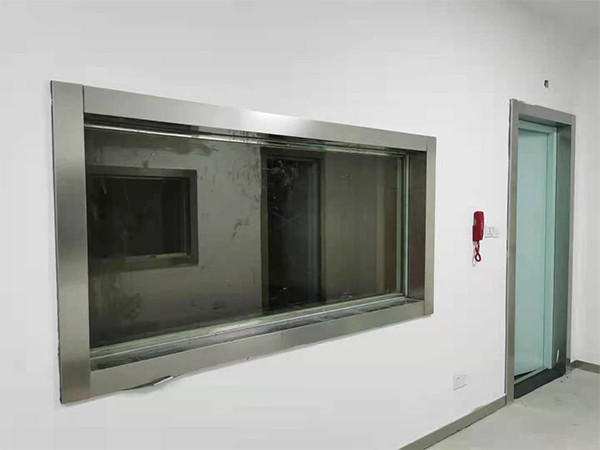
Introduction to Lead Glass
2026-06-16

一. Main Categories
Based on function and lead content, lead glass is mainly divided into two categories, each with clear application boundaries:
1. Protective Lead Glass: High lead content, high density, with the core function of radiation shielding. It's mainly used in medical and industrial
protection settings. Common thicknesses are 10mm, 15mm, 18mm, and 20mm, corresponding to different levels of radiation protection, specifically
blocking harmful radiation like X-rays and gamma rays. It's the go-to material for radiation work environments.
2. Optical and Craft Lead Glass: Moderate lead content (around 24%), focusing on excellent optical performance, good light transmission, and high
refractive index. It's mainly used for making optical instruments, high-end crystal crafts, decorative containers, etc. Most crystal glass decorations
we see in daily life fall into this category.
二. Core Features
1. Excellent Radiation Protection Performance
Lead has an atomic number of 82 and a density of up to 11.34 g/cm³, much higher than ordinary glass. Thanks to its high density and high atomic
number, lead glass can effectively absorb and attenuate X-ray and gamma radiation through mechanisms like the photoelectric effect and Compton
scattering. It blocks radiation penetration while remaining transparent, perfectly solving the issue of traditional protective materials being opaque
and preventing real-time observation, making it a core material for visual radiation protection.
2. Outstanding Optical Performance
Compared to ordinary glass, lead glass has a refractive index of 1.5–1.7, excellent dispersion, and uniform, clear light transmission. Light passing
through it can refract into gorgeous rainbow-like reflections with a smooth, warm feel and no color distortion. The glass is fine-textured, highly flat,
and has minimal optical distortion, meeting the imaging requirements of precision optical equipment.
3. Good Crafting and Physical Properties
Lead glass has a lower melting point and moderate viscosity, making it easy to fire and process. It can be cut, ground, polished, and shaped,
suitable for complex designs. It is also hard, wear-resistant, and resistant to deformation, with good chemical stability—resistant to common acids
and alkalis, and not easy to oxidize or age, giving it a long service life. Additionally, its density is much higher than regular glass, giving it a heavy
feel, which is one of the obvious ways to identify lead glass.
4. Sound Insulation and Shock Absorption
Its high-density structure gives lead glass excellent sound insulation and vibration damping capabilities. It can effectively block airborne noise and
reduce vibration transmission, making it suitable for special soundproof observation windows, providing protection, transparency, and sound
insulation all at once.
The performance and features of lead glass
How to choose radiation protection medical lead sheets?