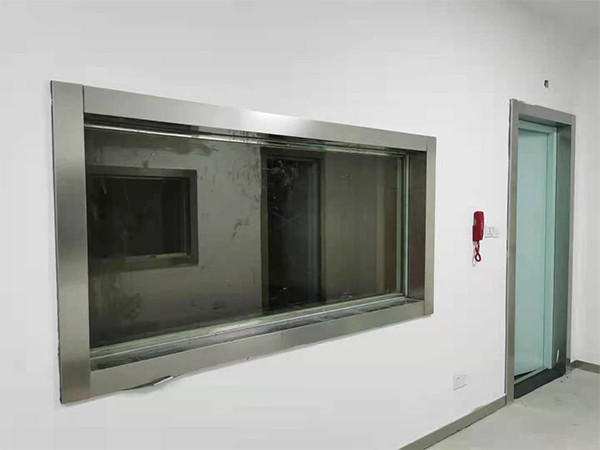
The performance and features of lead glass

Lead glass has the advantages of high lead content, strong protective capabilities, good oxidation resistance, non-toxicity, no impurities, and no bubbles. Lead glass has a light transmittance of 85%. Among them, lead glass contains 26% lead and 15% barium. The abundant lead and barium content make the density of lead glass higher than national standards!
Lead glass is a transparent protective material that resists X-rays. It can be used in radiological diagnostics, treatment facilities, nuclear medicine, and industrial radiation protection. This gives lead glass better protection; The installation of lead glass observation windows must be equipped with professional lead glass frames to ensure the safety and radiation leakage prevention of lead glass. The lead glass frame is made of stainless steel and comes with medical-grade lead plates.
Since the hospital radiology department uses radiation-protective glass, the performance of radiation-protective lead glass is a common concern for both manufacturers and customers. Currently, there are many manufacturers of radiation-proof glass on the market, and many hospitals often struggle when purchasing it. So, what factors should be considered when purchasing radiation-protective lead glass?
Shielding refers to using substances with higher atomic numbers, usually lead or lead-containing substances, as barriers to absorb unnecessary X-rays. Distance protection refers to the principle that the amount of X-ray exposure is inversely proportional to the square of the distance, reducing the amount of exposure by increasing the distance between the X-ray source and the human body. Lead glass is radiation-resistant and transparent. When X-ray exposure is within the allowable range, the impact of lead glass is generally minimal. People don't have to refuse necessary X-rays and CT scans because of radiation, let alone be afraid to enter radiology departments.
Radiation-protective lead glass should be stored in a dry, well-ventilated place. Do not rinse with water, or some spots may appear. If there are some spots, we can wipe them with absorbent cotton and ethanol. Because glass is less stable, we should stay away from these chemicals such as paint and thinners. If they come into contact with each other, the glass is easily oxidized. In a short time, we can clean with ethanol. If it doesn't work, contact a professional.
Radiation-protective lead glass is a brittle material. Due to its relatively large specific gravity, caution should be taken during use. When lead glass is fixed to a window, it should be sealed with lead sheet or lead glue to prevent light from leaking through. When installing radiation-protective lead glass, the window frame should not use wet wood. Because when the wood shrinks, the lead glass is damaged. The surface of radiation-protective lead glass should not touch or rub against hard or rough objects to prevent marks.
Technical Requirements for X-Ray Protective Clothing
Introduction to Lead Glass